

Diwali 2026 Date and Laxmi Puja Muhurat
Diwali 2026 falls on Sunday, 8 November 2026. The main Laxmi Puja is performed that evening during the auspicious Pradosh and Amavasya window, with vidhi involving cleaning the home, lighting diyas, and worshipping Goddess Laxmi and Lord Ganesh together using the standard samagri list for a prosperous and auspicious year ahead.
Book online
Book Pooja Online, talk to our team and schedule your pooja.
Diwali 2026 falls on Sunday, 8 November 2026. Every year I get the same question from clients: "Vedic astrologer ji, muhurat kitne baje hai?" The honest answer is that Lakshmi Puja only really works inside Pradosh Kaal combined with a Sthir Lagna, and that window is barely an hour and forty five minutes long. Here is the full date, the muhurat logic, the vidhi, and the samagri list, written the way I would explain it to a family sitting in front of me.
Diwali 2026 date and tithi
Kartik Amavasya begins late on the evening of 7 November 2026 and runs through the evening of 8 November. Lakshmi Puja needs Amavasya to be active during Pradosh Kaal (the twilight hour after sunset), and that condition is met on 8 November, so that is the main Diwali day. The full five day sequence stays standard: Dhanteras a couple of days earlier, Choti Diwali and Naraka Chaturdashi on 7 November, Lakshmi Puja on 8 November, Govardhan Puja on 9 November, and Bhai Dooj on 10 November. If you also want the Choti Diwali rituals sorted, I have written those up separately in the Choti Diwali 2026 guide.
Diwali 2026 Laxmi Puja date and muhurat
To answer it directly, the Diwali 2026 Laxmi Puja date is 8 November 2026, and the puja itself should be performed after sunset that evening, inside Pradosh Kaal. This is the single most searched detail every year, so here is the full muhurat breakdown for exactly when to start.
Lakshmi Puja shubh muhurat
The Pradosh Kaal Lakshmi Puja muhurat for 2026 sits roughly between 5:40 PM and 8:15 PM for Delhi NCR timing, and you should still cross check the exact minute against your own city's Panchang because sunset time shifts things east to west. Inside this broader window, the Sthir Lagna (fixed ascendant) falls in Vrishabha Lagna, roughly from 6:15 PM to 8:10 PM. That overlapping 1 hour 45 minute stretch is the classically preferred slot for inviting Lakshmi ji, because a fixed sign rising is believed to make the wealth and blessings that enter the house that night stay put rather than slip away. For those doing tantrik sadhana, Mahanishita Kaal runs roughly 11:40 PM to 12:32 AM, but that is a specialised practice, not the family puja window.
| Window | Approx time (Delhi NCR) | Use |
|---|---|---|
| Pradosh Kaal | 5:40 PM to 8:15 PM | Broad Lakshmi Puja window |
| Vrishabha Lagna (Sthir) | 6:15 PM to 8:10 PM | Ideal overlap, most preferred |
| Mahanishita Kaal | 11:40 PM to 12:32 AM | Tantrik sadhana, not standard family puja |
Puja vidhi, step by step
Start cleaning the house at least three days before. On the day itself, bathe, wear fresh silk or cotton clothes, and set up a chowki in the north east corner of your main room. The sequence I follow is: Ganesh sthapana to the left of where Lakshmi will sit, place the Lakshmi idol or photo, set up a Kalasha with Gangajal and mango leaves, take a Sankalpa naming your gotra and nakshatra, do Ganesh puja, then Kalasha puja, Navagraha smaran, 108 recitations of the Lakshmi Ashtakshari mantra, a reading of the Sri Suktam, Kubera puja, and finally the aarti. After the puja, light diyas in every room of the house and keep the main door open, since the belief is that Lakshmi ji should be able to enter freely.
Samagri list
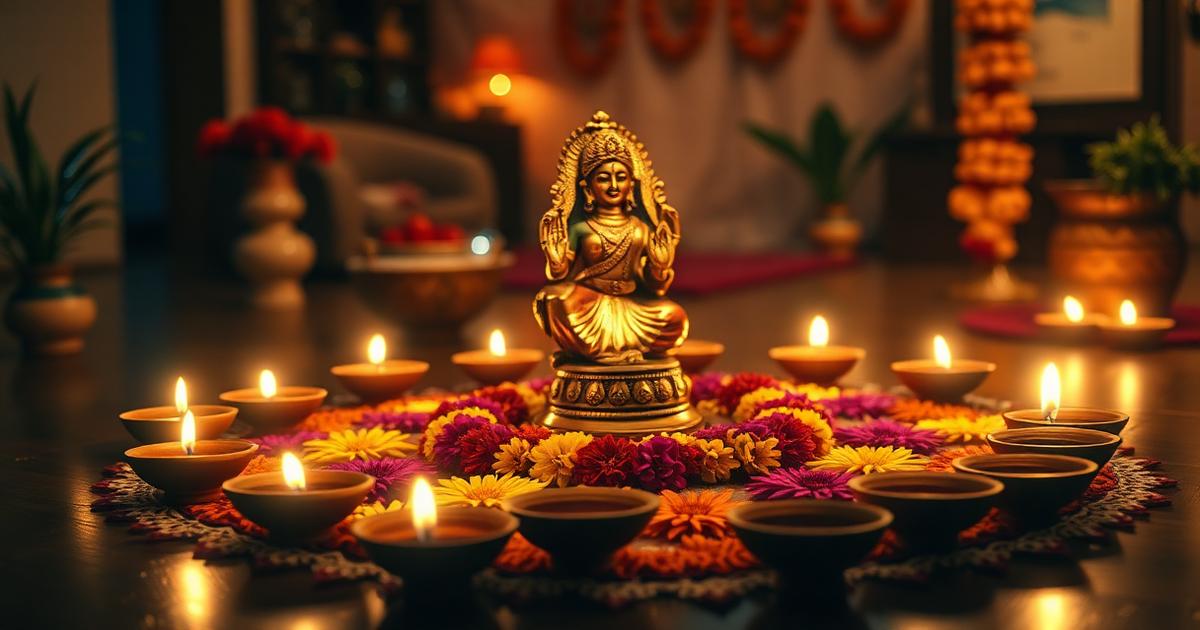
A fresh Lakshmi Ganesh idol, red cloth for the chowki, a copper or silver Kalasha, Gangajal, five mango leaves, a coconut, roli, chawal, kumkum, haldi, red flowers (lotus if you can get it), five supari, five elaichi, five laung, at least twenty one diyas, cotton wicks, pure ghee, kheel batasha, gud, panchamrit, dhoop, agarbatti, and a Sri Yantra or Kuber Yantra if you plan to keep one in your locker or cash box afterward. Many families also buy a new broom on this day as a symbolic first entry of Lakshmi into the house.
Common mistakes to avoid
- Starting the puja before Pradosh Kaal begins. Amavasya with Ganesh Lakshmi only activates after sunset.
- Using steel diyas. Clay or brass is the classical material, steel is a modern shortcut best avoided for this one night.
- Clicking photos or videos on the phone during the aavahan and aarti. Keep the attention on the puja itself.
- Removing the Lakshmi idol from its seat right after the puja ends. Leave it in place for at least 24 hours.
Regional variations
North India centres the evening on Lakshmi Ganesh puja. In Bengal, this same Amavasya is celebrated as Kali Puja instead. Gujarat treats the night as Chopda Pujan, when businesses open new account ledgers. In Tamil Nadu and Andhra Pradesh, the bigger day is actually Naraka Chaturdashi on 7 November, marked with an oil bath before sunrise. The underlying Amavasya Pradosh muhurat stays the same everywhere, only the format on top of it changes by region.
Story and symbolism
Diwali marks Ram ji's return to Ayodhya, when the citizens lit rows of diyas to welcome him home. The same Kartik Amavasya is also linked to Mahalakshmi's emergence from the Samudra Manthan, which is why the Lakshmi puja carries so much weight on this particular night. Lighting the deep is meant as a movement from tamas toward light, from ignorance toward knowledge, which is really the whole point of the festival beyond the fireworks and sweets.
Remedies and next steps
- Avoid salt, oil heavy food, and non-vegetarian meals on the day of the puja itself.
- Draw a swastik and a rangoli at the main door, as a symbolic path for Lakshmi ji's entry.
- For eleven days after Diwali, keep lighting one diya outside the main door every evening.
- Bring the new broom home quietly, without haggling over it, since it is treated as a form of Lakshmi.
- Place the Kuber Yantra in your locker or cash box only after the puja, once it has been energised.
- If you run a business, do Chopda Pujan inside the Sthir Lagna window and start your new ledger there.
If Diwali also happens to be your birthday or falls close to a major life decision, it is worth checking what your own chart says about that week. You can pull up your placements any time in the free Kundli tool, or ask the AI astrologer chat for a quick read on your Diwali muhurat questions.
A real example
A family last year insisted on doing Lakshmi Puja at 9 PM because that is when relatives could gather, well outside the actual Pradosh Kaal plus Sthir Lagna window for their city. The classical position is that the ritual timing matters more than convenience, so moving the puja earlier to fit the real muhurat, even with fewer guests present at that exact moment, is the better call. Confirm the exact Pradosh window for your city before fixing a time, and book a Vedic astrologer online if you want the muhurat calculated for your exact location.
What this can't tell you
A generic muhurat table cannot calculate your city's exact sunset and Pradosh Kaal to the minute, metro cities a few hundred kilometres apart can differ by 10-15 minutes, which matters for a 105-minute window.
Related reading
Founder & Lead Vedic Astrologer, AstroFuture AI · Reviewed 5 October 2026
Aashish has been studying Vedic astrology, KP paddhati and Chaldean numerology for over 12 years. He founded AstroFuture AI to make classical Jyotish accessible without the roughly $24 consultation fee. Every article on this blog is written or reviewed by him personally.
Want your own chart or numerology report?
Frequently Asked Questions
Free tools for this topic
Apply what you just read to your own chart, no payment needed.
Related articles
Choti Diwali 2026: Date, Muhurat aur Puja Vidhi
6 min read
Navagraha Shanti Puja: Benefits, Cost & Correct Day
7 min read
Daily Panchang Guide: Tithi, Nakshatra, Rahu Kaal and Choghadiya
9 min read
Hariyali Teej 2027: Date, Muhurat and Vidhi for Punjab & Haryana
7 min read
Janmashtami 2027: Date, Nishita Muhurat, Vrat Vidhi and Samagri
7 min read
Amavasya 2026: Full Date List, Puja Vidhi and Fasting Rules
7 min read